


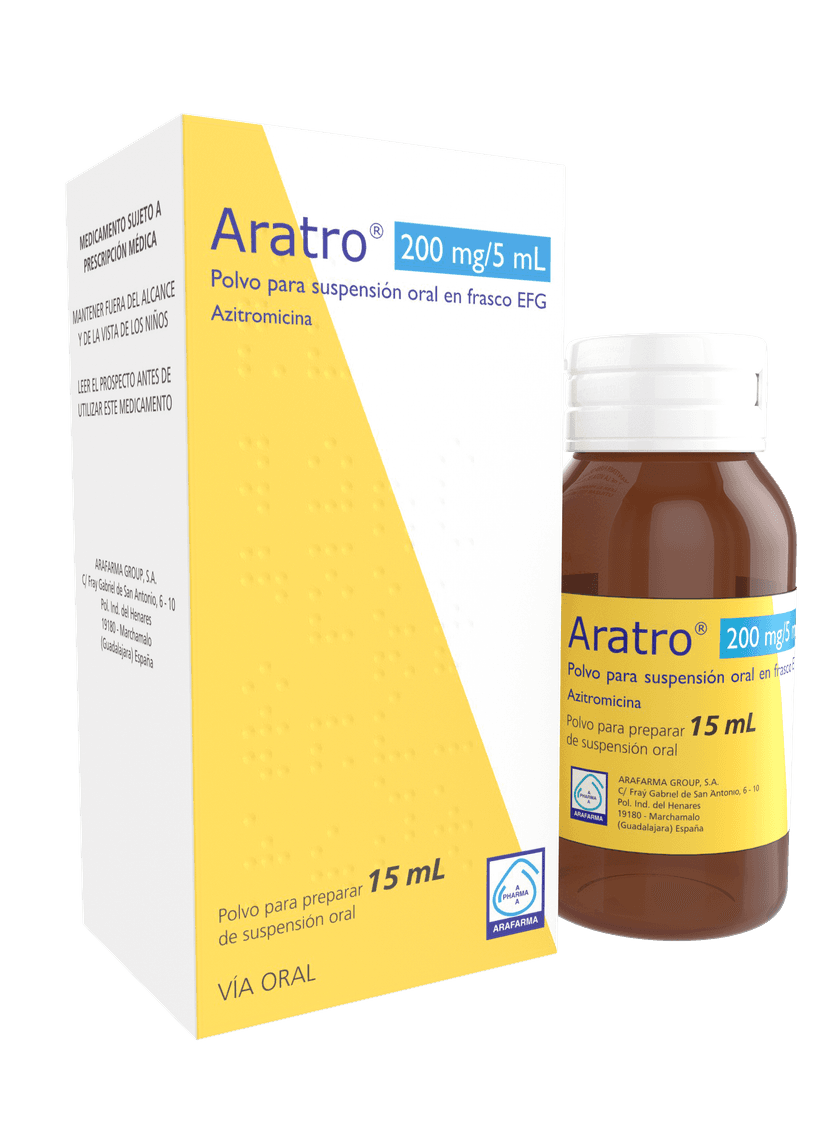
Aratro Powder for preparation of suspension.
Product properties
Available as a powder for preparation of an oral suspension in a bottle. Each pack contains one 15 ml or 30 ml bottle.

Instructions for use
Composition
Each 5 ml of suspension contains: Active substance: Azithromycin 200 mg. Excipients: sucrose, hydroxypropylcellulose, anhydrous trisodium phosphate, xanthan gum, cherry flavouring, containing ethanol, sodium, glucose from maltodextrin and sulphites; vanilla flavouring, containing ethanol, sodium, glucose from maltodextrin and sulphites; and banana flavouring, containing ethanol, sodium, glucose from maltodextrin and sulphites.
Description: available as a powder for preparation of an oral suspension in a bottle. Each pack contains one 15 ml or 30 ml bottle.
Pharmacological properties
Each 5 ml of suspension contains: Active substance: Azithromycin 200 mg. Excipients: sucrose, hydroxypropylcellulose, anhydrous trisodium phosphate, xanthan gum, cherry flavouring, containing ethanol, sodium, glucose from maltodextrin and sulphites; vanilla flavouring, containing ethanol, sodium, glucose from maltodextrin and sulphites; and banana flavouring, containing ethanol, sodium, glucose from maltodextrin and sulphites.
Indications
Caused by microorganisms:
infections of the upper respiratory tract and ENT organs: pharyngitis/tonsillitis, sinusitis, otitis media; infections of the lower respiratory tract: acute bronchitis, exacerbation of chronic bronchitis, pneumonia, including pneumonia caused by atypical pathogens; infections of the skin and soft tissues: erysipelas, impetigo, secondarily infected dermatoses, moderate acne vulgaris, for tablets; early stage of Lyme disease, borreliosis — erythema migrans; infections of the genitourinary tract: urethritis, cervicitis caused by Chlamydia trachomatis, for tablets and capsules.
Method of use
Oral use.
The medicine must be reconstituted before use. To facilitate administration, each bottle is supplied with a dosing syringe with three built-in scales allowing dosing in kg, from 0 to 40 kg, according to body weight; in ml, from 0 to 10 ml, according to the volume of suspension; and in mg, from 0 to 400 mg, according to the amount of active substance. This medicine may be taken with or without food.
Follow exactly the instructions for use of this medicine given to you by your doctor or pharmacist. If in doubt, consult your doctor or pharmacist.
Your doctor will determine the most appropriate dose and duration of treatment for you depending on your condition and response to treatment.
Weight, kg Dosage regimen 1 Dosage regimen 2 Bottle size, ml < 15* Take 10 mg/kg/day as a single dose. Day 1: take 10 mg/kg once. Days 2–5: take 5 mg/kg once. 15 ml 15–25 200 mg, 5 ml, as a single dose. Day 1: take 200 mg, 5 ml, once. Days 2–5: take 100 mg, 2.5 ml, once. 15 ml 26–35 300 mg, 7.5 ml, as a single dose. Day 1: take 300 mg, 7.5 ml, once. Days 2–5: take 175 mg, 3.75 ml, once. 30 ml 36–45 400 mg, 10 ml, as a single dose. Day 1: take 400 mg, 10 ml, once. Days 2–5: take 200 mg, 5 ml, once. 30 ml
Contraindications
Consult your doctor or pharmacist before taking this medicine.
During treatment with azithromycin, allergic-type reactions may occur, such as itching, redness, skin rash, swelling or difficulty breathing, or an allergic reaction to the medicine characterized by an increased number of white blood cells in the blood and generalized symptoms. These reactions may be serious. Inform your doctor, who may decide to discontinue treatment and prescribe appropriate therapy. If you have liver problems, or if during treatment with this medicine your skin and/or the whites of your eyes become yellowish, inform your doctor immediately so that he/she can determine whether you should stop treatment or whether liver function tests should be performed. If you are taking ergotamine derivatives, used for the treatment of migraine, inform your doctor, as concomitant treatment with azithromycin may cause an adverse reaction called ergotism. During treatment with this medicine, there is a possibility of fungal infection. If this occurs, inform your doctor. During or after treatment with this medicine, symptoms resembling antibiotic-associated colitis, such as diarrhea, may occur. In this case, treatment should be discontinued, and your doctor will prescribe the treatment he/she considers most appropriate. If you have severe kidney impairment, inform your doctor. If you suffer from a disease called myasthenia gravis, or if during treatment with this medicine you develop muscle weakness and fatigue, inform your doctor, as this medicine may worsen the symptoms of this disease or trigger it. If you suffer from heart rhythm disorders, arrhythmias, or have predisposing factors, such as certain heart diseases, changes in blood electrolyte levels or the use of certain medicines, inform your doctor, as this medicine may worsen these disorders or trigger them.
Side effects
Like all medicines, this medicine can cause side effects, although not everybody gets them.
Side effects reported during clinical studies and in the post-marketing period have been classified by frequency:
Very common side effects, occurring in at least 1 in 10 patients:
Diarrhea.
Common side effects, occurring in at least 1 in 100 patients:
Headache. Vomiting, abdominal pain, nausea. Changes in the number of certain types of white blood cells, lymphocytes, eosinophils, basophils, monocytes and neutrophils; decreased bicarbonate.
Uncommon side effects, occurring in at least 1 in 1,000 patients:
Candida fungal infection in the mouth or generalized Candida infection, vaginal infection, pneumonia, fungal or bacterial infection, pharyngitis, gastroenteritis, breathing disorder, rhinitis. Decreased number of certain types of white blood cells, leukocytes, neutrophils and eosinophils. Allergic reaction, including inflammation of deeper layers of the skin, angioedema. Changes in eating behaviour, anorexia. Nervousness, insomnia. Drowsiness, dizziness, taste disturbance, loss of tactile sensation. Visual disturbance. Hearing disturbance, vertigo. Constipation, flatulence, indigestion, gastritis, difficulty swallowing, abdominal bloating, dry mouth, belching, mouth ulcers, increased salivation. Rash, itching, appearance of raised reddish welts, dermatitis, dry skin, increased sweating, redness. Joint inflammation, muscle pain, back pain, neck pain. Difficulty urinating, kidney pain. Vaginal bleeding, changes in the testicles. Generalized swelling, weakness, malaise, fatigue, facial swelling, chest pain, fever, pain and swelling of the limbs. Changes in liver function tests, increased liver enzymes GOT and GPT and alkaline phosphatase; increased bilirubin, urea, creatinine, chlorides, glucose, bicarbonates and platelets in the blood; changes in sodium and potassium levels; decreased hematocrit. Post-operative complications.
Rare side effects, occurring in at least 1 in 10,000 patients:
Agitation. Liver dysfunction, yellowing of the skin. Sensitivity to sunlight, photosensitivity; drug reaction with increased white blood cell count, eosinophilia, and generalized symptoms involving many organs, DRESS syndrome. Skin rash characterized by the rapid appearance of areas of red skin covered with small pustules, small blisters filled with white/yellow fluid.
Side effects of unknown frequency, frequency cannot be estimated from the available data:
Diarrhea caused by Clostridium difficile. Decreased platelet count in the blood, anemia. Severe allergic reaction. Aggressive reactions, anxiety, delirium, hallucinations. Loss of consciousness, seizures, decreased sensitivity, hyperactivity, change and/or loss of sense of smell, loss of taste, muscle weakness and fatigue. Hearing impairment, including deafness and ringing. Bidirectional tachycardia, heart rhythm disorders, QTc interval prolongation on the electrocardiogram. Decreased blood pressure. Inflammation of the pancreas, tongue discoloration. Severe liver damage and liver failure, rarely leading to fatal outcome, death of liver tissue, fulminant hepatitis. Appearance of raised reddish welts, generalized rash with blistering and peeling of the skin, especially around the mouth, nose, eyes and genitals, Stevens-Johnson syndrome; severe skin reactions such as erythema multiforme and toxic epidermal necrolysis. Joint pain. Acute renal failure and inflammation of the tissue between the renal tubules, interstitial nephritis.
Reporting of side effects
If you experience any side effects, consult your doctor or pharmacist, even if these are possible side effects not listed in this leaflet.
You can also report them directly through the Spanish Pharmacovigilance System for Medicinal Products for Human Use at: www.notificaram.es. By reporting side effects, you can help provide more information on the safety of this medicine.